Professor Jimoh Bola Akolo (1934–2023): A Pillar of Nigerian Art
My first reaction to hearing the name Jimoh Akolo was great excitement. This was followed by sadness and deep grief. I was saddened by the fact that I never got to meet Professor Jimoh Akolo. I only heard about him in 2024, which prompted me to begin researching his life. Why was this important to me? It was important to me because, as a daughter of Egbe and an ABUSITE, we shared both an ancestral and educational lineage.
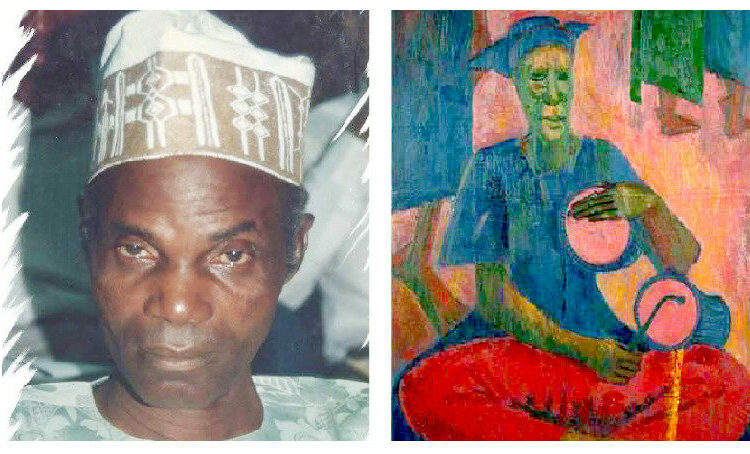
Professor Jimoh Bola Akolo, often known simply as Jimo Akolo, was a Nigerian painter, academic, and one of the true pioneers of modern art in Nigeria. He was born in Egbe, Kogi State, in 1934, where his earliest exposure to art came through his grandfather, a master weaver whose craft left a deep impression on him as a child. He was the first professor to come from Egbe.
Professor Akolo’s artistic journey began at Government College Keffi, where a colonial education officer, Dennis Duerden, recognised his talent and encouraged him toward art rather than engineering.
He went on to study at the Nigerian College of Arts, Science, and Technology in Zaria (now part of Ahmadu Bello University), graduating in 1961. While there, he became part of the influential Zaria Art Society, a group of young artists who rethought art education in Nigeria and pushed for a balanced blend of Nigerian artistic heritage and modern technique.
Akolo’s pursuit of excellence took him beyond Nigeria. He studied at Hornsey College of Art in London, and later at Indiana State University in Bloomington, USA, where he earned both a Master of Science in Education (1966) and a Doctorate in Art Education (1982).
In 1966, Akolo joined the faculty of Ahmadu Bello University, Zaria, where he taught for more than three decades. He became a Professor of Art Education and played a key role in shaping the teaching and practice of visual arts in Nigeria. His influence extended well beyond his own work, touching students, colleagues, and the broader creative community.
Akolo was known for paintings that drew deeply on indigenous cultural traditions, everyday life, and Northern Nigerian landscapes and peoples.
He did not paint abstract concepts far removed from daily experience. Instead, he brought lived subjects into careful formal balance. Themes like horse riders at festivals, wrestlers, milkmaids, and quiet scenes of daily labour. His works carry strong colours, thoughtful structure, and a measured, almost architectural sense of space that reflects both his early artistic discipline and his exposure to a wide range of traditions.
His control of form and colour was admired as both modern and deeply rooted in Nigerian realities. This blend helped define a uniquely Nigerian modernism in visual art.
Akolo’s work was shown widely, both in Nigeria and internationally:
- Solo shows and group exhibitions in London, including at the Commonwealth Institute.
- Participation in international biennials, such as the Havana Biennial in Cuba.
- Exhibitions at the National Gallery of Art, Abuja, and many others.
His works have also appeared in major museum collections and have been sold at international auction houses, confirming his place as one of Nigeria’s leading artists.
Later Years and Legacy
Professor Akolo retired from teaching in 1998 but remained respected as both creator and thinker in Nigerian art. He was known for his quiet personality.
He was a man who avoided the limelight but was deeply committed to his craft and students.
On 3 June 2023, Akolo passed away after a brief illness at the age of 88, leaving behind a body of work and a generation of artists and art educators shaped by his influence.
Today, he is remembered as a foundational figure in Nigeria’s modern art history, not only for his paintings but for his role as teacher, mentor, and builder of artistic culture in the country.