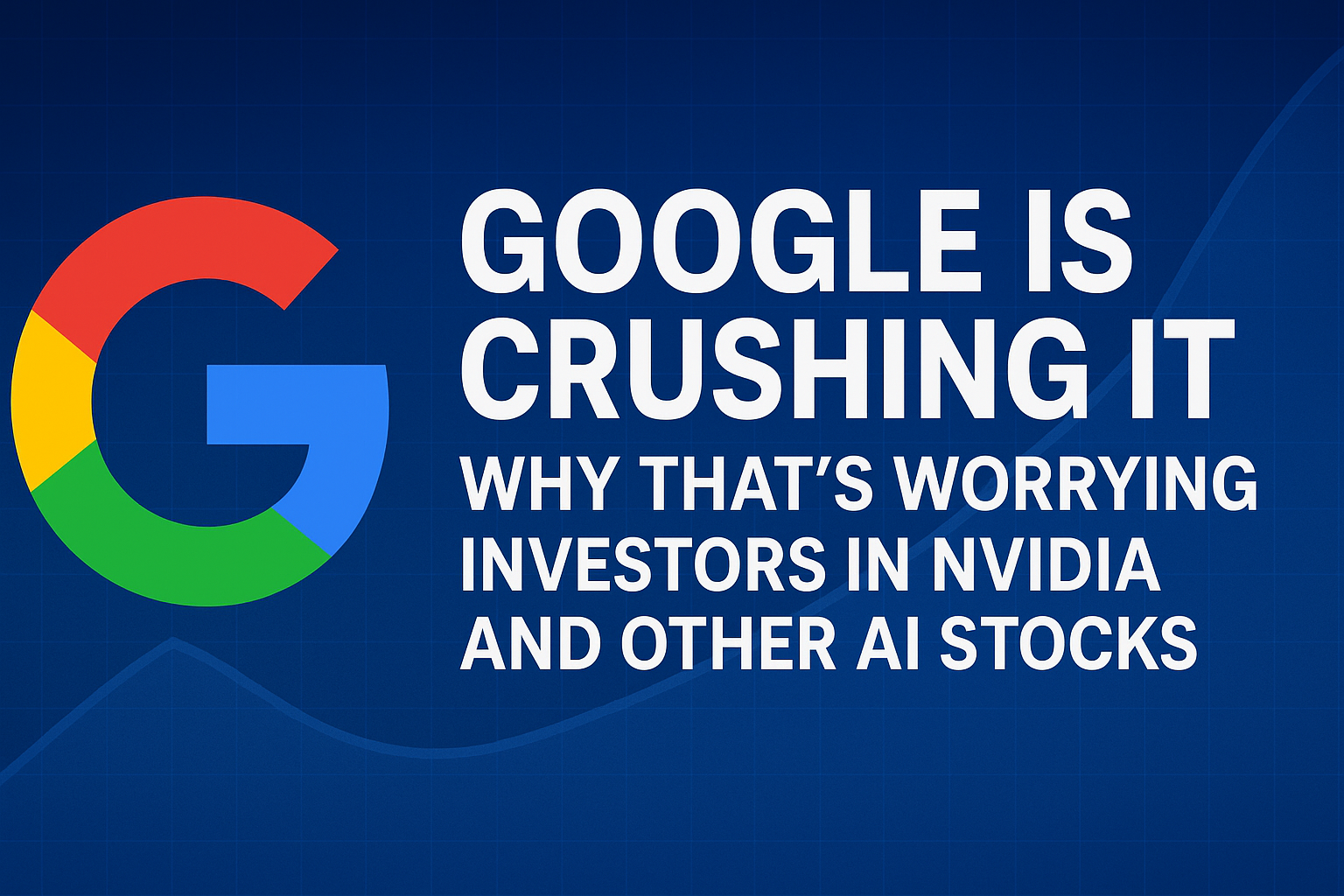
Google Is Crushing It — Why That’s Worrying Investors in Nvidia and Other AI Stocks
Google is having one of its strongest moments in the AI race and the tech world is paying close attention. From breakthroughs in AI models to massive investments in custom chips and data centers, Google’s momentum is undeniable. But while the headlines look great for Alphabet, this rapid rise is sparking concern among investors in Nvidia and several other AI-focused companies.
Here’s a breakdown of why Google’s success is raising eyebrows on Wall Street and what it means for the future of the AI industry.
Google’s AI Surge: A Threat to Competitors?
For years, Nvidia has been the backbone of AI development. Its high-performance GPUs power advanced models, cloud workloads, autonomous vehicles, and more. But Google’s recent AI advancements suggest that the AI ecosystem may not rely as heavily on Nvidia in the future.
1. Google Now Builds Its Own AI Chips — And They’re Getting Better
One of the biggest shifts is Google’s growing investment in Tensor Processing Units (TPUs) — custom-built AI chips specifically designed for machine learning at scale. These chips are now powerful enough to compete with the latest Nvidia GPUs in certain tasks such as large-scale training, inference, and model deployment.
Google’s ability to build its own hardware is a strategic advantage. It means:
- Less dependency on Nvidia’s expensive GPUs
- Faster improvements tailored to Google’s AI needs
- Lower long-term infrastructure costs
- More control over cloud-AI performance
When a tech giant stops relying on a supplier, investors take notice. And that’s exactly what is happening in the AI market today.
2. Gemini 3 and Google’s “AI Everything” Strategy
Google’s new generation of AI models — especially Gemini 3 — has shown impressive performance across multiple benchmarks. These models aren’t just catching up to competitors; in some areas, they’re pulling ahead.
Google’s strategy is clear:
- Build more powerful AI models
- Host them on Google Cloud
- Run them on Google’s own chips
- Integrate them deeply across products like Search, YouTube, Gmail, Android, and Workspace
This full-stack AI dominance creates a competitive moat that few companies, including Nvidia, can easily penetrate.
Investors fear that if Google continues to excel at both model development and AI infrastructure, other players especially those heavily dependent on GPU demand could lose their growth advantage.
3. Massive AI Infrastructure Spending
Google is also pouring billions of dollars into new data centers and advanced AI hardware. Its AI-focused capital expenditure has reportedly hit the highest level in company history.
Why that matters:
- More in-house AI means less GPU buying from Nvidia
- Google Cloud becomes more competitive
- Google’s AI costs shrink in the long term
- Alphabet’s operating leverage increases
What worries investors most is that Google’s infrastructure buildout hints at a future where hyperscalers like Google, Amazon, and Microsoft begin producing more of their own AI chips, reducing reliance on Nvidia.
4. Nvidia’s Dominance Could Be Challenged
Nvidia’s GPUs remain the gold standard in AI training, but early signs of long-term disruption are emerging.
Key risks investors are watching:
- Custom AI chips from Google, Amazon, and Microsoft
- Increased competition from AMD and AI accelerator startups
- Cloud providers shifting toward their own silicon
- AI workloads moving from training-heavy to inference-heavy (cheaper to run)
While Nvidia still controls the market today, Wall Street is forward-looking — and Google’s moves signal the beginning of a new era where Nvidia’s monopoly could soften.
5. The “Hyperscaler Effect” — Big Tech Is Reducing Its Dependency
One of the biggest fears among Nvidia investors is what analysts call the “hyperscaler effect.”
Hyperscalers Google, Amazon, Meta, Microsoft are the largest buyers of Nvidia’s AI chips. If even one of them cuts spending due to in-house chip development, Nvidia’s future revenue outlook could change dramatically.
Google’s TPU expansion is the clearest example of that shift.
Why this matters:
- Hyperscalers = ~80% of Nvidia’s data center revenue
- Losing even one giant customer hurts
- It signals a broader trend — independence from GPU suppliers
This is why Google’s successes aren’t just impressive; they’re potentially disruptive.
6. Market Reaction: Rising Google, Nervous Nvidia
Whenever Google announces major AI breakthroughs, Nvidia’s stock often reacts — even if only subtly. Investors understand that competition at this level can reshape entire industries.
Recent market behavior shows:
- Alphabet stock surges with AI announcements
- Nvidia stock experiences short-term dips or slowed momentum
- Analysts warn of long-term competition risk
- AI sector volatility increases
Investors aren’t panicking, but they’re preparing for a future where Google becomes an even bigger AI powerhouse one that doesn’t rely on Nvidia’s hardware.
7. Should Nvidia Investors Really Be Worried?
Not necessarily — at least not in the short term.
Here’s why Nvidia still looks strong:
Nvidia’s strengths remain unmatched:
- Industry-leading GPU performance
- Massive demand for AI training
- A powerful software ecosystem (CUDA)
- Strong relationships across cloud platforms
- Rapid hardware innovation cycle
- Even Google still buys Nvidia chips — for now. And the broader AI boom isn’t slowing down.
But the long-term concern is real: if more companies build in-house AI silicon, Nvidia may face tougher competition than ever before.
8. What This Means for the Future of AI
Google’s success highlights a major shift in the AI landscape:
- AI is becoming vertically integrated
Companies want their own AI models, chips, infrastructure, and cloud services.
- Big Tech is fighting for AI dominance
Google, Microsoft, Meta, Amazon, and OpenAI are all racing to control the future of AI.
- Nvidia must innovate faster than ever
Its dominance is secure for now — but not guaranteed forever.
- Investors are preparing for structural changes
The AI market is evolving from a GPU-driven ecosystem to a multi-chip, multi-platform world.
Final Thoughts
Google is undeniably crushing it in the AI race from powerful new models to advanced custom chips and massive infrastructure expansion. While this is great news for Alphabet, investors in Nvidia and other AI stocks are watching closely, concerned that Google’s momentum could eventually disrupt the GPU-driven AI industry.
Nvidia remains strong today, but Google’s rise signals a future where AI becomes increasingly competitive, decentralized, and vertically integrated.
This next phase of the AI revolution is just getting started and Google has positioned itself at the center of it.