Abuja Art Fair Positioning As Major Cultural Capital Globally
For five days, the Federal Capital Territory, Abuja was literally immersed in the creative energies of Nigerian artists at the recently concluded Abuja Art Fair.
The Abuja Art Fair is a significant event that underscores Nigeria’s commitment to promoting cultural diversity, creativity and artistic expression. It is a celebration of the power of art that brings people together, to inspire, and to transform.
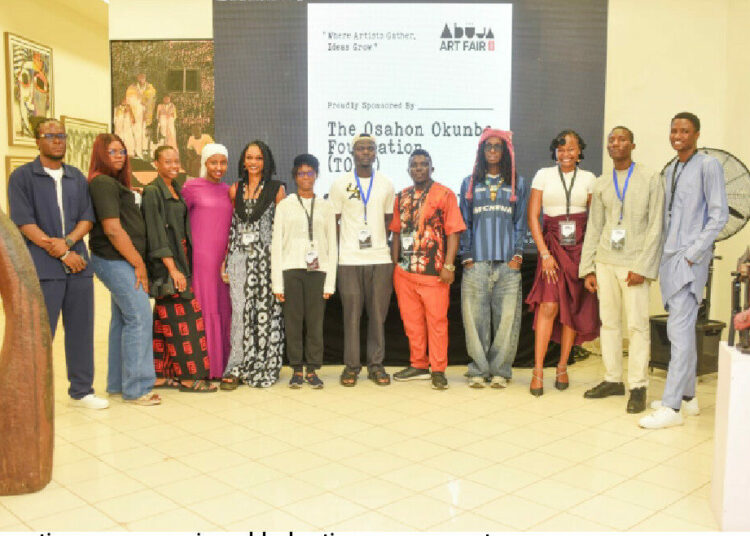
At the venue 12-year-old Exhibition Pavilion, Area 10, Abuja. Organised by the Thought Pyramid Art Centre, the maiden Abuja Art Fair with the theme Art in the Heart of Nigeria, was solely sponsored by the Osahon Okunbo Foundation and it evolved into a meeting point where stories took shape, identity found voice, and culture gathered momentum, Assistant Editor (Arts) OZOLUA UHAKHEME reports
From the onset, the mission of the organisers of the inaugural Abuja Art Fair was unambiguous. It was a deliberate intervention an unequivocal declaration that Abuja is ready to claim its rightful place as a major cultural capital.
This led to the establishment of an inclusive, purpose-built, nationally representative platform that democratises access to artistic expression and nurtures a truly pan-Nigerian creative ecosystem.
Expectedly, the ambience of the Exhibition Pavilion, which hosted the fair between December 3rd and 7th, provided the needed space and setting for the celebration and promotion of creative talents of the ‘modern masters, generational masters, and contemporary’ artists.
It is also to place art at the core of Nigeria’s identity, civic discourse, and collective aspirations, particularly in a diverse and dynamic society like Nigeria, ‘art is far more than an aesthetic embellishment it is a vital force capable of sustaining, challenging, and reshaping the consciousness of its people.’
Ajueshi said that the fair was born from years of planning, dreaming, and praying a vision to create an alternative platform where artists can meet, engage, and build meaningful relationships with collectors, enthusiasts, and the wider public.
“Today, we celebrate not only the success of the fair, but also our indomitable spirit that carried us through,’ he stated. Ajueshi stressed that the Abuja Art Fair 2025 positions itself as a vital point of convergence where traditional, modern, and contemporary artistic practices meet, interact and evolve.
“Its mission is expansive and urgent: to collect, study, conserve, and exhibit works that articulate the complexity, resilience, and ingenuity of the Nigerian people, both within the country and across the global diaspora. The artworks presented here have been thoughtfully curated to provoke inquiry and spark dialogue.
They confront the defining issues of our time environmental wide sustainability, civic responsibility, technological transformation, humanitarian agency, and the indispensable place role of women in shaping Nigeria’s future.
“It is especially meaningful that these conversations take place in Abuja, the heart of our democracy, where art can most powerfully interrogate, illuminate, and inspire,” he noted.
The initiative, according to Ajueshi, was to make a bold assertion that Nigeria’s capital deserved a world-class cultural institution capable of nurturing creativity and sustaining artistic scholarship.
“Abuja became the canvas upon which my vision for a transformed Nigerian art ecosystem took shape, matured, and ultimately flourished with the establishment of our purpose built Centre.
The Osahon Okunbo Foundation reassured that its mission is to widen that space deepening access, championing talent, and strengthening the pathways that allow Nigerian creators to rise.
It said that by backing the first edition of the Abuja Art Fair, ‘we help expand the visibility for artists in Abuja and across Nigeria, ensuring their work takes its place in both national and global conversations.
Our partnership with Thought Pyramid Art Centre reflects a shared commitment to honouring the depth of Nigerian expression and enriching the cultural landscape of the capital. For TOOF, this collaboration affirms a simple belief: when artists are supported, culture expands and possibilities multiply.’
From the intricate wood carvings of grand masters to the stunning brush feels of young strokes that inch their ways to people’s hearts, the Abuja Art Fair stands as a testament to the incredible diversity of African culture.
The interactive exhibitions, workshops, and discussion sessions and mentoring sessions, while showcasing works by legendary artists such as Bruce Onobrakpeya, Ben Osawe, Twin Seven Seven, Jimoh Buraimoh, Rufus Ogundeke, Kolade Oshinowo, Amos Odion, Muraina Oyelami, Emmanuel Ekefrey, Adebisi Fabunmi and Bisi Fakeye.
No fewer than 42 masters that also featured included Sam Ovraiti, Alex Nwokolo, Adetola Wewe, Yomi Momoh, Ebong Ekwere, Ada Godspower, Gbenga Offo, Oviri Alaric, Pius Emorokpor, and Juliet Ezenwa Maja-Pearce.
Others were Abba Adams, Abdulfatai, Abdulsalman Musa, Ahmed Michael, Emmanuel Ageyeye, Etuk Unyime, Henry Iliya, Julius Oda, Mahmoud Nalado, Oluwatobi Ajibola, Oyewole Abubakar, Uyota Omadoye, Agboola Emmanuel and Blessing Miracle. Among the Abuja artists were Akachukwu Emeka, Milicent, Sor Sen, Tom Sunday and Uche Uguru
President Society of Nigerian Artists, Mr. Muhammad Sulaimon who was excited by the growth of art awareness within the city of Abuja, said the fair is not just about Nigerian or African art; it is also a celebration of the rich global art heritage with its own unique souls.
Similarly, Miss Kelechukwu Beatrice Nelson described the fair as a successful marriage of traditional, contemporary and modern art. “It is almost successful because the exhibition of traditional art works tilted majorly towards Benin art. Indeed, it was a colourful event and I look forward to another edition more spectacular than this one,” she said.